MoCoTalk: Multi-Conditional Diffusion with Adaptive Router for Controllable Talking Head Generation

Imperial College London
International Joint Conference on Biometrics (IJCB '26)
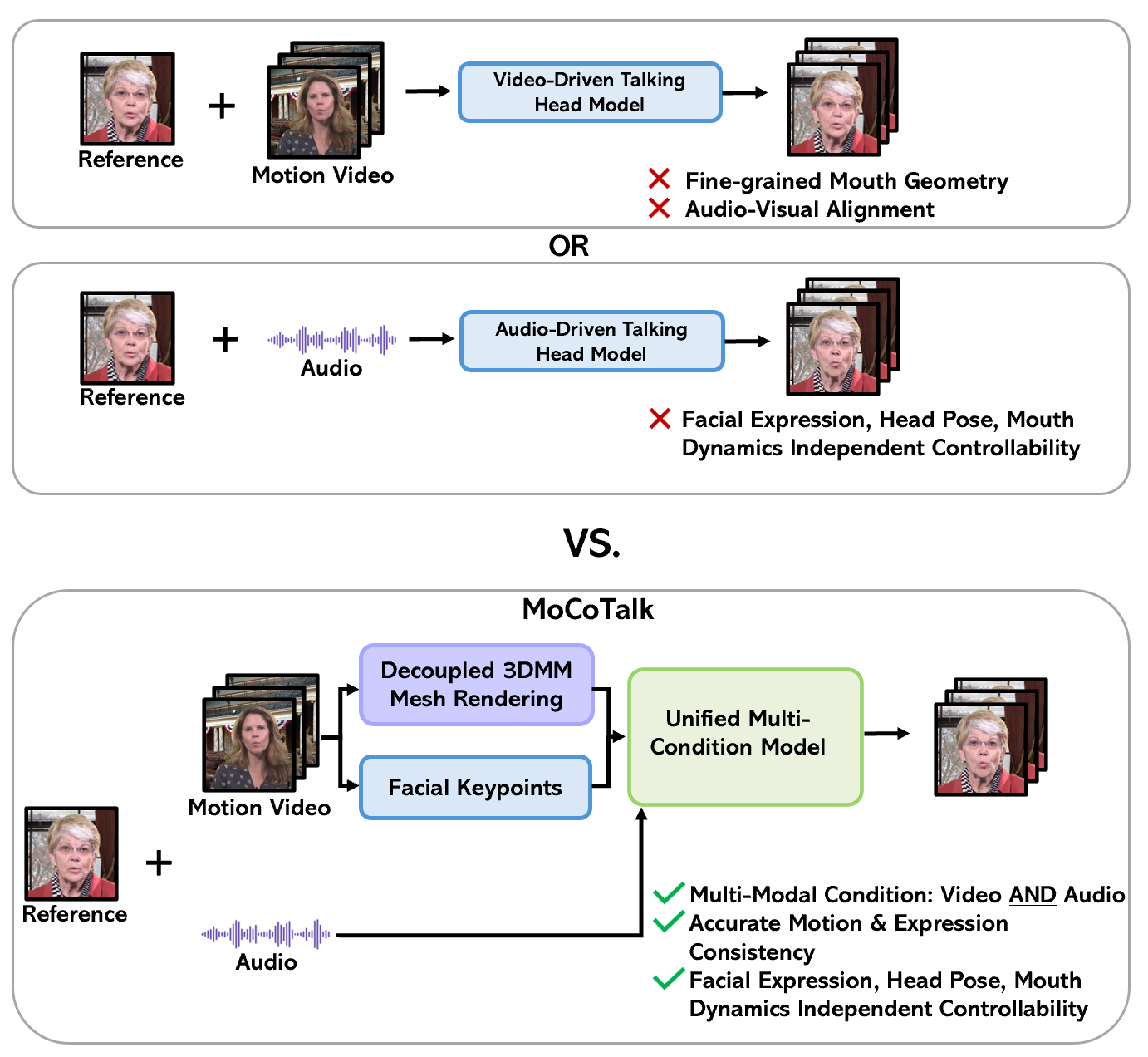
Video-only and audio-only talking-head models compared with MoCoTalk, which takes video, keypoint, mesh and audio conditions at once.

Video-driven methods follow the driving video but ignore speech; audio-driven methods follow speech but give little control over pose or lighting. MoCoTalk takes all of them as conditions at once, with independent control of facial expression, head pose and mouth dynamics.

Abstract

Talking-head generation requires joint modeling of identity, head pose, facial expression, and mouth dynamics. Existing methods typically address only a subset of these factors, and rely on fixed-weight or heuristic fusion when multiple conditions are involved. We present MoCoTalk, a multi-conditional video diffusion framework that unifies four complementary control signals: a reference image, facial keypoints, 3DMM-rendered shading meshes, and the corresponding speech audio.

To resolve destructive interference among heterogeneous conditions, we introduce an Adaptive Multi-Condition Router that computes channel-wise, timestep-aware gating over the four condition streams, allowing the fusion strategy to vary with both feature subspace and noise level. To better capture speech-related facial dynamics, we design a Mouth-Augmented Shading Mesh, a 3DMM-based representation that decouples head motion, mouth motion, expression, and lighting. This design provides a temporally consistent geometric prior and allows flexible recombination of these attributes at inference. We further introduce a lip consistency loss to tighten audio-visual alignment.

Extensive experiments show that MoCoTalk achieves state-of-the-art performance on the majority of structural, motion, and perceptual metrics, while offering attribute-level controllability that single-condition methods do not provide.
Method Overview

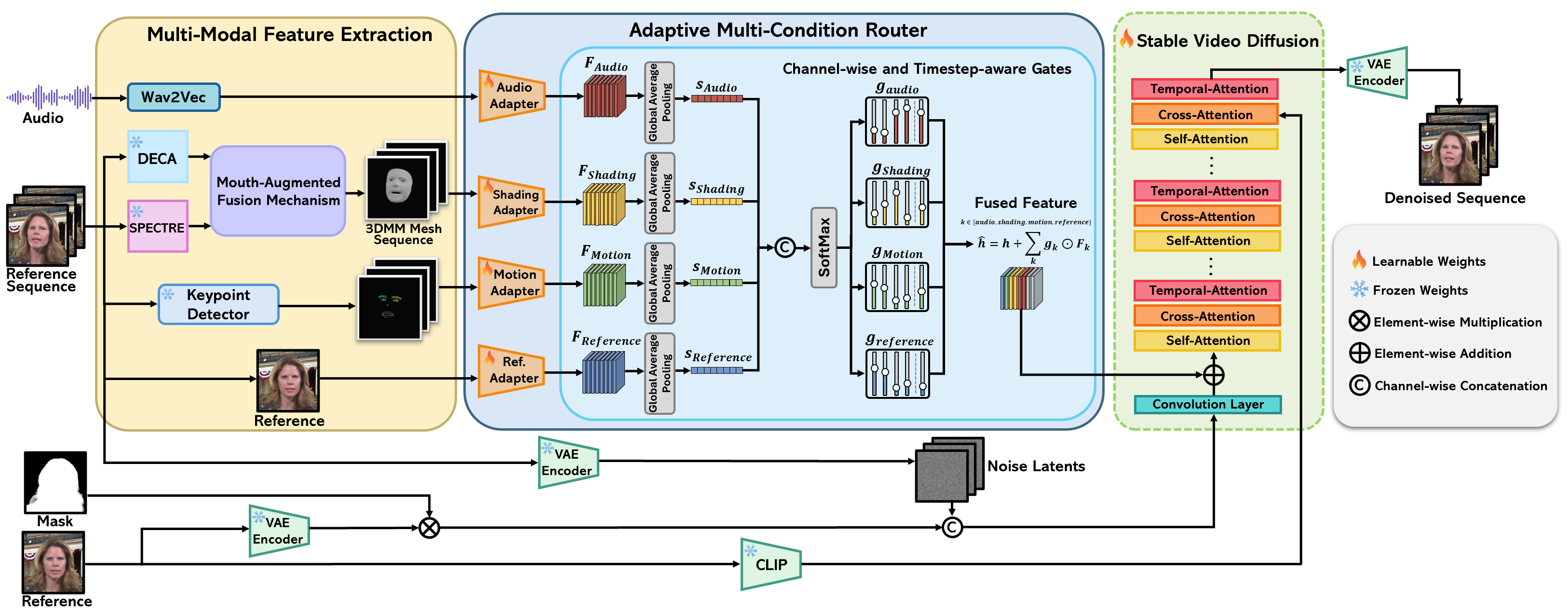
MoCoTalk architecture: four condition adapters feed an Adaptive Multi-Condition Router that fuses them into the shallow U-Net feature of a Stable Video Diffusion backbone.

MoCoTalk accepts four complementary conditioning signals: a reference portrait, facial keypoints, mouth-augmented 3DMM shading meshes and speech audio. Lighting, shape, pose and expression are extracted from video frames with DECA and SPECTRE and rendered into the shading mesh; the audio is encoded by Wav2Vec2 into a windowed feature sequence. Four parallel adapters lift the signals into spatially aligned latent maps, and the router fuses them into the shallow U-Net feature through channel-wise gating. The fused feature guides a Stable Video Diffusion backbone to denoise the video latents.

1

Adaptive Multi-Condition Router

Pools each condition, the U-Net feature and the timestep embedding, then predicts a softmax gate per channel over the four branches:

h = hunet + Σk gk ⊙ ck

Missing conditions are masked out, so any subset of conditions works at inference.

2

Mouth-Augmented Shading Mesh

Identity and lighting from DECA, mouth and expression from SPECTRE plus a DECA residual, head pose from a separate video. Head motion, mouth motion, expression and lighting can each come from a different source.

3

Lip Consistency Loss

A 1 − cos loss between frozen lip-reading features of predicted and ground-truth mouth crops, which tightens audio-visual alignment of the mouth region.

Mouth-Augmented Shading Mesh

Fitting DECA to each frame on its own produces weak, jittery mouth shapes. Replacing the mouth-region coefficients with those recovered by SPECTRE, while keeping DECA's global head motion, gives a mesh that follows the speech closely and stays stable over time.

Results

Evaluated on HDTF against Diff2Lip, VideoReTalking, SadTalker, Hallo2, LivePortrait and LCVD (our baseline). Each clip plays all methods in sync, so every column can be compared frame by frame.

Self-Reenactment

The model reconstructs the driving video of the same identity, so the driver is the ground truth.

Cross-Reenactment

A driving video of one person animates the reference portrait of another.

Quantitative Comparison

HDTF, first 100 frames of each test video. Best in bold.

Self-reenactment Cross-reenactment
Method SSIM↑PSNR↑LPIPS↓FVD↓AED↓APD↓AKD↓VQA↑ID↑Sync-C↑ AED↓APD↓ID↑
VideoReTalking0.736522.090.0976279.90.198450.383.2390.55260.60394.1530.238790.720.8488
Diff2Lip0.741522.550.0916211.30.127746.332.7660.55960.87134.4790.247190.860.8703
SadTalker0.729022.020.108064.660.116254.663.0600.46910.91693.9690.238495.460.9159
FLOAT0.451514.580.309291.880.136076.113.9460.71920.88574.3340.234890.090.8815
Hallo20.715221.780.098387.620.120544.722.7080.68730.89294.4430.243486.660.8923
LCVD0.720921.480.109397.450.123413.901.5290.74770.77621.1630.246691.260.7705
MoCoTalk (ours)0.799823.550.081040.750.102813.851.3930.63200.83821.1910.238289.600.8293
7 / 10self-reenactment metrics where MoCoTalk is best
−37%FVD vs. the next best method (40.75 vs. 64.66)
14×higher FVD without the router (592.5)

Ablation Study

Self-reenactment Cross-reenactment
Variant SSIM↑PSNR↑LPIPS↓FVD↓AED↓APD↓AKD↓VQA↑ID↑Sync-C↑ AED↓APD↓ID↑
w/o Adaptive Router0.771723.080.1286592.50.135918.551.6480.58060.67391.1570.253696.780.6844
w/o Lip Consistency Loss0.782822.710.092593.070.111714.841.4560.67620.80431.1710.247194.850.8001
w/o Mouth-Augmented Mesh0.800423.610.080541.510.103013.971.4940.62920.83801.1820.2655100.80.8065
Full model0.799823.550.081040.750.102813.851.3930.63200.83821.1910.238289.600.8293
  • The router matters most. Replacing it with fixed additive fusion raises FVD about 14× (40.75 → 592.5) and lowers ID by 18–20% in both the self and cross settings.
  • The lip loss improves motion accuracy (AED, APD, AKD) and cross-identity transfer.
  • The mouth-augmented mesh mainly helps cross-reenactment: without it, Cross APD rises from 89.6 to 100.8, while per-frame reconstruction metrics barely change.

BibTeX

@inproceedings{ye2026mocotalk,
  title     = {MoCoTalk: Multi-Conditional Diffusion with Adaptive Router for Controllable Talking Head Generation},
  author    = {Ye, Xinyan and Deng, Jiankang and Edalat, Abbas},
  booktitle = {Proceedings of the IEEE International Joint Conference on Biometrics (IJCB)},
  year      = {2026},
  eprint    = {2605.08050},
  archivePrefix = {arXiv}
}